It probably says something about my myopic view of the world that I could never really get with Urbis. To me it always seemed a soulless space with a paltry veneer of art and heavily edited culture splattered on the inside. This might well be because I've spent a lot of my time in the intellectual company of very dead, fairly bearded white men, with the result that I can often feel out of touch with the prevailing views on arts and culture.
My issue with Urbis is that it never provided me with the intellectual sustenance I was looking for... though to be frank, few exhibition do. I'm like a man who has been spoiled by a doting mother and excessive pornography, it is unlikely I will find a lady who will live up to my expectations. Little short of the Great Exhibition of 1851 will please me.
This view hasn't changed with the decision to forcibly inject the National Football Museum in Urbis' glassy shell. I'm not going to retrospectively become horrified by football's ascendancy into a cultural space. In some ways it's a bit of a relief: I'll never feel that I'm somehow letting down the middle class art lovers side by my reluctance to subject myself to the cultural fare Urbis offered. It's football, and, like tripe, no one will mind if I turn my nose up at it.
Looking round Urbis on a rainy Sunday afternoon, it became clear to me that perhaps I should apply the same logic to the attitude of display that currently infuses the space. Audio-visual interpretative displays and blown-up photographs for me have always had a supplemental purpose - yet with Urbis they are the mainstay of both major exhibitions currently on display. The suggestion of smugness, which so offended their CEO, is not rescinded: the exhibitions remind me of nothing more than complacent secondary school text books, which the key difference that there is apparently no attempt to present a unbiased argument. Both the TV and Hip Hop exhibitions feel celebratory to the point of being blinkered.
However, I do understand that many people love the place, and with this in mind it's clear to see that the major issue with the Urbis decision is that it smacks of the same dangerous logic which inspired Southampton Council to attempt to sell art to funda Titanic-themedtourist attraction. Economic decisions cannot be ignored when planning culture, but the public floundering over it the future of Urbis makes it seem that there has been no planning for something to take its place.
Just as the exhibitions seemed to sit superficially in the surroundings of that god-awful arrogant buildings, perhaps when removed from it they could take on a new subtleness and nimbleness? When I was 19 I wrote a plan for a building-less Gallery of Popular Culture - even then I knew that a building would hamper rather than help a curatorial idea which attempted to pin down something so ephemeral. I still have the document somewhere... if you're interested.
Unless you follow me on Twitter you either don’t know or don’t care that my home town is the rather unfortunate city of Southampton. When I was younger I had a complete and utter lack of affection for this place, and left, working my way as far away from the town of my birth by attending increasingly northern academic institutions.
I seldom go home, despite nostalgia somewhat returning in my old age. However, it does indicate something if I still refer to my parent’s house as home.
Undoubtedly where you’re from shapes you, and I realise now that I perhaps did not give Southampton due credit for shaping some of my artistic sensibilities. The Southampton City Art Gallery, as well as being a beautiful building, houses a large collection of Graham Sutherland paintings. Sutherland will always be a touchstone for me when it comes to thinking/feeling about art. Perhaps this civic art gallery has shaped what I think/feel about art institutions.
Anyway, I digress.
My mama cajoled me into attending Desiring Necessities at the John Hansard Gallery. This small gallery is located in the heart of the excessively landscaped Highfield Campus of the Southampton University.
I was wary at first, since Desiring Necessities looked like it was going to be one of those overly curated beasts which clumsily miss-handles popular culture in the gauchest of manners…
… and wonderfully, I was pleasantly surprised.
The art writer Michael Bracewell - who writes in the free catalogue ( downloadable from here ) - hit the nail on the head why this exhibition appeals so deeply. In his opening words he summed it up as being, “Personally important but perhaps not academically respectable.”
Dealing with veins of iconography running through popular culture, the curator Ilaria Gianni manages to tread a very fine path. This exhibition almost completely avoids the pitfalls that often cripple exhibitions dealing with similar themes. Delicately constructed, the works lie together nicely, neither jarring each other or drawing their interconnectedness with too broad strokes.
A still from Susanne Burner’s video 50,000,000 CAN’T BE WRONG
Thoughtfully approaching usually gnarly subjects; nostalgia is examined without straying into schmaltz, cultural anxieties without hysteria and deals with popular culture in an intelligent and delicate manner which still manages to be powerful and oddly respectful.
Bracewell – who has rocketed in my estimation, despite rather clumsily name dropping Morrisey – touches on other aspect which makes this exhibition so evocative and compelling, that these artists manage to deal with popular culture without trying to trump it. It’s a fact - Bracewell quoting someone and I miss-quoting him - that artisans working in popular culture are often more sophisticated than the artistic types that mimic them. This is something which was never better illustrated than the often clumsy State of the Art : New York at Urbis.
Why do I like this exhibition so much? Evocative of the hidden rivers of meaning/language/text that runs through culture, it approaches subjects without having to tie them down too forcefully. There is something experiential and not dictatorial about it that I really appreciate.
The definite highlight of the exhibition is Susanne Burner’s video 50,000,000 CAN’T BE WRONG, depicting scenes of modern hysteria, audiences and crowds to a sound track of ghostly music. This hypnotic video could perhaps completely reverse my oft-stated attitude to video art. It sets the tone of the entire exhibition, melancholic and suggestive of something more, without having to state or explain itself.
Hopefully when I return to Manchester I can find the time and energy to write some more about what’s happening, but for the time being my excursion down south has been well worth it.
I am behind the times in nearly all senses of the phrase, finally getting myself down to Urbis to go see State of the Art : New York today.
If I had to imagine a parody of a collection of quintessentially New York-ian art - based upon, having never been there, poorly remembered adverts from Art Forum and far too much CSI : NY - it would look almost exactly like this exhibition. Almost entirely State of the Art: New York consists of a ugly mish-mash of hip-hop imagery and trite clumsy pomo heavy rhetoric.
You can just imagine the types of people who made this stuff, people for who cool was a career choice. The US equivalent of those people who end up living in Hebden Bridge with unused AGAs and fixed gear bicycles, probably an undiagnosed STI or two and writing smug self-referencing nonsense for the weekend supplements.
If this was an episode of CSI: NY I know exactly what would happen. The beautiful cool artist is actually plagiarising the work of his/her lover with the collusion of the shady gallery owner, who is probably trafficking crystal meth in pop culture referencing art works. The lover kills the artist in an appropriately artistic manner, the greedy gallery owner looks to make a killing as the value of the artists work sky rockets, but is revealed to be a drug smuggler and the lover gets to live out his/her days in solitude indulging their artistic urge in the comfort of the the prison cell. The squinty eyed guy says something twee and everyone else pisses about with tech looking pretty to the tune of whatever the cool hunters are saying will be the "big thing". The Who plays.
Anyway, unfortunately, it's not an episode of CSI : NY. It's another smug and achingly cool exhibition at Urbis.
I should have been an art critic in the fifties. When modernism was actually modern. Just imagine the things I would have said to Greenberg....
Are you Christmas-ed out yet? The farcical queues in Paperchase and the Post Office making you want to tear your eyes out?
I'm on the downward swing into Scrooge-osity, and however much I adore fairy lights, need a seasonal antidote.
Luckily, the new photography exhibition at Urbis looks like it could be just the boy for the job.
Opening tomorrow and called Reality Hack, the exhibition consists of a series of newly commissioned works from experimental photographer Andrew Paul Brooks, documenting his journeys behind the scenes of Manchester.
First glance seems to indicate that it'll be riffing of that contemporary surreal atmosphere which made me fall in love with the Jamie Baldridge exhibition at Richard Goodall. ( Incidentally, you still have a few more days to go see that, since it is finishing on the 7th.)
Manchester is an incredibly vibrant, exciting and eclectic city, and its art scene reflects that. However, in a city as large and diverse as this, with several distinct areas just within the city centre, it can get a little overwhelming.
To counteract this and to help you get the most out of this city has to offer, here's a brief guide to some of the major and not so major galleries around Manchester.
From the big internationally acclaimed civic institutions through to small artist led galleries and emerging artists cropping up in unlikely places, from the wilds of the Northern Quarter to the cosy enclaves of university campuses, artistically, Manchester has something for everyone.
Civic Galleries
In terms of big civic galleries, there is a plentiful supply. Manchester Art Gallery has a great collection of art, with over 25,000 objects. The gallery has a particularly fine and extensive collection of Victorian and Pre-Raphaelite painting and objects on permanent display, including the seminal painting by Ford Madox Brown, Work. But the gallery is not restricted to the nineteenth century, with a collection spanning six centuries, it also has a significant examples of eighteenth century and contemporary works. Whether you want to gaze upon William Blake or Lucian Freud, there is something for you.
Located on Moseley Street, just opposite the central library and St. Peters Square - as well as on the very edge of China Town - Manchester Art Gallery is housed in two fine Victorian buildings. These building are joined together with a stunning glass atrium and stair well area, designed by the award winning architect Sir Michael Hopkins, and opened in 2002 to critical acclaim.
The atrium itself has been used as a space to display art work, as demonstrated this summer by these amazing sculptures by Korean artist Choe U Ram.
Totally different but equally exalted is Urbis, which stands out in the middle of Manchester's shopping melee pit like neatly crash landed spaceship. Striking up into the ( often) gloomy Manchester sky it looks like a cousin of the Pompidou Centre with it's guts tucked in.
Incredibly trendy, Urbis styles itself as a " exhibition centre about city life." The current exhibition displays the political works Emory Douglas, the first and only Black Panther Minister for Culture.
Housing a popular cafe, a top floor restaurant which offers unequalled views of the city, as well the painfully cool, seasonal bar The North Pole located in an adjacent marquee, Urbis is a social, as well as cultural, hub.
The Cornerhouse, nestling next to the Oxford Road Station, has, along with its cinema, book shop and bar facilities, three floors of dedicated exhibition space.
Unfortunately the quality of the exhibits can be quite variable, positive reaction Masaki Fujihata exhibition was undermined by the current exhibition, The Interwining Line.
The downstairs cafe-bar area, which affords an unrivalled people-watching panorama across the hurly burly of Oxford Road, currently features stills from the Academy Award nominated animated film, Persepolis.
Not to be forgotten is the Chinese Arts Centre in the Northern Quarter. The Chinese Arts Centre is the international agency for the development and promotion of contemporary Chinese artists.
Commercial Galleries
Sometimes it's fun to see how the other half live, and even more fun to pretend to be them. Not everyone has the dosh to take a trip to a commercial art gallery as a customer, but that shouldn't stop you having a good nose around. The city centre has several interesting commercial art galleries, most notably the two Richard Goodall Galleries in the Northern Quarter and the Philips Art Gallery on Tib Street.
Richard Goodall Gallery's first location is on Thomas Street, which claims to be the UK's leading fine art photography, limited edition silk screen rock poster art and low brow art emporium. To you and me that's very expensive posters and toys. Still it's nice to see what the über trendy lot spend their money on.
The more recognisable arty face of RGG is the Contemporary Gallery, located in a specially built, state of the art building on High Street in the Northern Quarter. In real terms it's just by that weird set of flats with the old market facade and just opposite Sweet Mandarin.
Currently on show are the stunning photographs of Jamie Baldridge , recently reviewed for Citylife.co.uk, this exhibitions finishes on the 7th of December. This crowd pleasing show is to be followed by an exhibition which promises to be even more popular, in the wildly sought-after illustrator Nicoletta Ceccoli's largest exhibition to date. The galleries' flickr photostream gives a good sense of what the gallery space is like and what kind of exhibits they put on.
Although not nearly on the scale of the Richard Goodall Galleries, the Philips Art Gallery is worth a visit. Hidden away on Tib Street, this tiny, charming space is always full of a broad and interesting selection of art. The displayed work are refreshingly unfashionable, ranging from contemporary representative and impressionist works, through to fifties and vorticist paintings. Their Christmas Exhibition opens on the 27th of November and runs until the 20th of December.
Artist Run Galleries
There are two great artist run galleries, the Castlefield Gallery and International 3. Opening this week at the Castlefield Gallery is a solo sculpture exhibition by Laura White called If I had a Monkey I wouldn't need a TV.
University Run Galleries
Moving away from the city centre and up Oxford Road, the universities unsurprisingly provide a couple of great art venues. Manchester Metropolitan University has a sequence of gallery spaces on it's All Saints Campus, such as The Holden Gallery, which recently housed the Third Manchester Artists' Book Fair. Continuing the bookish theme, this gallery currently contains an exhibition called Reflective Stories, displaying examples of sketchbooks and journals from all levels of art practitioners. Reflective Stories continues to the 12th of December.
Just up the stairs and around the corner from the Holden Gallery is the criminally under used Link Gallery. The gallery currently contains works by current and former students of the Interactive Arts course, in a practically named, Interactive Arts Alumni Exhibition, recently preview on Citylife.co.uk.
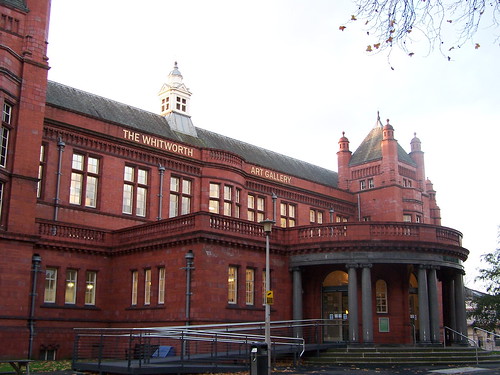
Any discussion about the arts around Manchester with out mentioning the Whitworth Art Gallery would be deplorable. This stunning red brick Victorian building is located on Oxford Road by Whitworth Park and is part of the University of Manchester.
It is home to some of the UK's finest collections of art and design including modern and historic fine art, prints, textiles and a rare collection of wallpapers. It's current and eclectic season of temporary display includes the stunning Putting on the Glitz, a celebration of burnished wallcoverings - an exhibition opened by Laurence Llwelyn-Bown earlier this month - and cloth & culture NOW, an unrivalled textile art exhibition featuring works from artists hailing from through-out Europe and Asia. Cloth & culture NOW is closing December 12th.
Arty Pubs
These are just a few examples of the more traditional places you can find art around Manchester. If your looking for more edgy, atypical art there is a whole plethora of less typical places to try. For example the recent Illuminations exhibit which was held in a disused building on Whitworth Street West.
However, its the city's pubs, bars and assorted drinking holes which often turn up trumps. Common in the Northern Quarter has a frequently changing decor supplied by emerging artists and illustrators. Strange Manchester staples of Odd and Odder have always had arty feel, and now Odder holds monthly exhibitions, providing an opportunity for local artists and designers to exhibit their work for free.
The famous Matt & Phred's Jazz Club in the Northern Quarter currently has on display a selection of images entered in the Shot Up North photography awards.
If you like your art with a little more narrative, you should head over to The Lass O'Gowrie. This classic Victorian pub, just off Oxford Road by the BBC, has a changing display of comic book art in the snug, currently featuring Adrian Salmon's Cybermen comics for Doctor Who Magazine.
Art Resources
This is only representative of a tiny selection of venues to see art around Manchester and as the end of the year approaches, old exhibitions taken down and new put in their place, this information will date very quickly.
However, do not despair, since Manchester is served by some great arts resources.
The first is the Arts List, covering every genre of visual and performative art, this is the definitive listings for the Manchester area.
Another useful resource to keep an eye on is Citylife.co.uk. Though the arts section is still, somewhat, in development, it promises to improve quickly. The online version of the Manchester Evening News supplement, it provides previews, news and reviews about entertainment and arts around the city, as well as competitions.
The Art Guide is seemingly a resource with yet untapped potential. Formerly the Castlefield Gallerys e-flyer, it provides details of many grassroots arts activities, as well as links to various arts organisations and collectives in the North-West.
There are probably many other great venues that I've failed to include, and if you feel I have left something significant out, be reassured it was not out of spite and please let me know via comments.
The Buy Art Fair is a chance to see how the other half live. Those with a fistful of fifty pound notes to throw around.
It must be a bit of a coup to get it at Urbis, that stunning building in the centre of Manchester, just across from the hell hole which is the Printworks and Next, the screaming baby and harried mother magnet. Urbis: It's shiney, it's cool, it's the Pompidou Centre with it's guts tucked it.
Even if you don't have a sweaty fistful of cash to sink into some 'art', the Buy Art Fair is an interesting experience. there is just so much art, compartmentalised into odd sized booths. A lot of it is quite cheesy, there are rather a lot of naked women and flowers in acidic colours on milky smooth surfaces. Dull and frankly rather 80's... In a bad way.
Richard Scott - 'pick an orange' from Beyond The Sea
But other stuff is rather lovely and cute, there are some glorious painterly pop-y images, birch trees and now and then stunning miasmic combinations of colour and form. It is interesting to see lots of images in a gallery space removed from that pernicious didacticism. Among the cacophony of images it is surprising what pictures take your fancy.
My scrubby art date was transfixed by photorealistic renderings of rivers and forests. If he had a pocket full of fifties he would have brought something. Perhaps, since he was headhunted by a model agency to photographed as Jesus, after his modelling debut.
Buy Art Fair is at Urbis until the 12th. There are various talks and 'debates', but these seem so aimed at those with purchasing power, they look pretty pointless for the rest of us.
...
Look... not a single mention of the credit crunch.


 Totally different but equally exalted is